We Won't Run Meta Ads for Accounting Firms Under $100/Day. Here's the Math Behind That Rule.
The minimum effective daily Facebook ad budget for an accounting firm is roughly $100 per day per ad set. Below that, Meta’s learning phase math falls apart. Meta’s own documentation requires 50 optimization events per ad set every 7 days to exit the learning phase. At any realistic cost per conversion, lower budgets cannot accumulate enough events to optimize.
I spent seven years coaching accounting firms on growth at Corvee under Andrew and Amanda Argue. The last four years I’ve been running Meta ads for firms in that same space. The budget question is the one I answer the most. Here’s the math that nobody publishes.
What’s the minimum daily Facebook ad budget for an accounting firm?
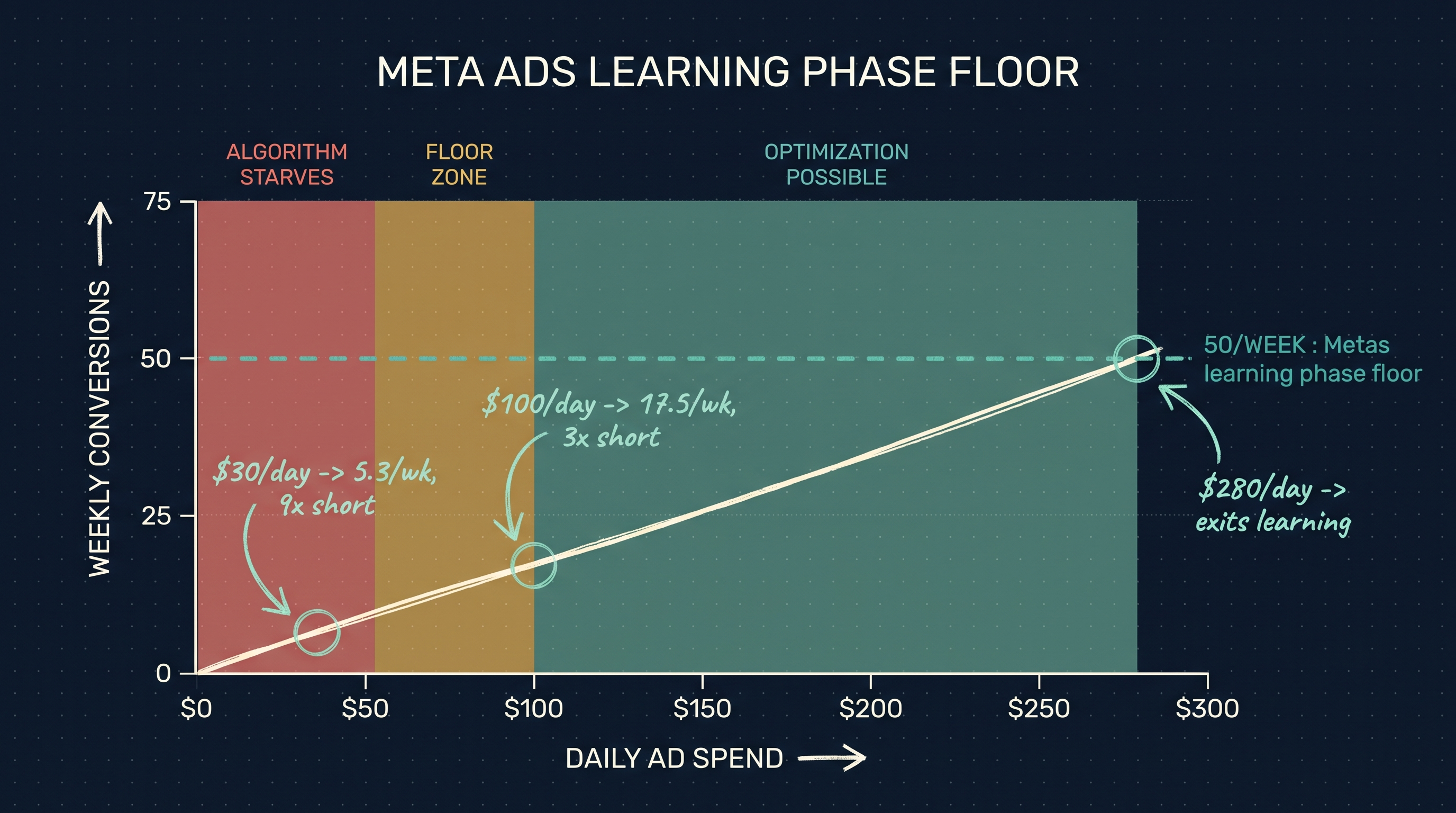
$100 per day per ad set is the floor. Below it, Meta’s algorithm cannot accumulate enough conversion data to exit the learning phase, and your ad sets stay in a permanent “Learning Limited” state. $100 per day is the minimum where the math can plausibly work with disciplined creative testing. The realistic operating range is $150 to $300 per day per ad set.
Here’s the thing. The floor and the target are two different numbers. The floor is what Meta needs to optimize at all. The target is what gets you predictable, scalable results. Most firm owners conflate them and end up funding the floor while expecting target-level outcomes.
How to read the budget zones:
| Daily budget per ad set | What it actually buys you |
|---|---|
| Under $30/day | Algorithm starves. Ad set never exits learning. The pixel never seasons. |
| $30 to $75/day | Stuck in learning. Performance swings wildly week to week. Most failed campaigns live here. |
| $75 to $100/day | Floor zone. The math closes only if your creative is excellent and your cost per conversion is unusually low. |
| $100 to $200/day | Workable for one consolidated ad set with strong creative and qualification. |
| $200+/day | Real optimization room. Multiple ad sets, A/B testing, scaling possible. |
Why $100, not $50 or $200? It comes from the math Meta itself publishes.
Why does Meta’s learning phase require 50 conversions per week?
Meta’s algorithm needs roughly 50 optimization events per ad set within a 7-day window to identify which audiences, placements, and times produce the best results. Below that threshold, Meta flags the ad set as “Learning Limited” and performance stays unstable. This requirement comes directly from Meta’s Business Help Center.
This isn’t an industry rumor. Meta publishes it directly in their Business Help Center documentation on the learning phase.
Their exact behavior: an ad set needs roughly 50 optimization events within a 7-day window after creation or any significant edit. Below that count, Meta labels the ad set “Learning Limited,” meaning it lacks the data to optimize properly. Cost per result swings. Reporting looks chaotic. The algorithm is doing its best with too little data to do anything useful.
In plain English: Meta is telling you that an ad set funded below this threshold cannot do the job you hired it to do. Not “will struggle.” Cannot. The math is theirs, not mine.
The 50/7 rule isn’t negotiable. You can’t email Meta and ask for an exception. Every Meta ads campaign on the platform runs into this same wall.
What does this mean for your own daily budget?
Your floor is whatever your cost per conversion is, multiplied by 50, divided by 7. That’s how many dollars per day you need per ad set just to meet Meta’s optimization threshold. Most accounting firms underfund this by 3 to 19 times and conclude the platform doesn’t work for their business.
Don’t take my number. Take your own.
Open your Meta Ads Manager. Look at the column for whatever conversion event you’re optimizing on, whether that’s lead form fills, calls booked, applications submitted, or page visits. Whatever your “Cost per result” reads, that’s the input.
Then run the math:
(Your cost per conversion × 50) ÷ 7 = your daily floor per ad set
A few worked examples:
- If your cost per conversion is $14, your daily floor is $100 per ad set.
- If your cost per conversion is $40, your daily floor is $286 per ad set.
- If your cost per conversion is $80, your daily floor is $571 per ad set.
$100 per day isn’t a universal floor. It’s the floor where the math can plausibly work only if your creative and qualification compress cost per conversion into the low double digits. For most firms running a normal funnel, the actual floor sits higher.
Run your math. The number Meta gives you isn’t optional.
Why the standard “$200 to $500 per month” advice is mathematically broken
The widespread advice that accountants should “start at $10 to $20 per day and scale to $500 per month if it works” is mathematically incoherent at any realistic conversion cost. At even moderate cost-per-conversion levels, those budgets produce a fraction of the weekly events Meta needs. The math doesn’t close.
Open any “Facebook ads for accountants” blog post. They all say roughly the same thing. Start small. Prove it works. Scale up. $10 per day. $200 per month. Maybe $500 if you’re “growth-focused.”
Let me run that math against Meta’s published rule. Worked example uses a $40 cost per conversion (plug in your own):
| What the standard advice says | What the math actually does (at $40/conversion) |
|---|---|
| “Start at $10 to $20/day” (about $450/month) | ~11 conversions/month, ~2.6 per week. Meta needs 50/week. 19x short. |
| ”$200 to $500 per month for established firms” | ~12 conversions/month, ~2.8 per week. 18x short. |
| ”$1,000+ per month for growth-focused” (~$33/day) | ~25 conversions/month, ~5.8 per week. 9x short. |
| Meta’s actual floor | $100/day, ~75 conversions/month, ~17 per week. 3x short, but closeable with strong creative. |
Now, I don’t blame any of the publishers for writing that advice. The advice exists because firm owners keep asking “what’s the lowest I can spend.” Publishers answer the question literally. But the algorithm doesn’t negotiate. 50 events per 7 days. Either you’re funding past it or you’re funding learning that never finishes.
This is the same shape as why most December marketing shutdowns turn into May post-mortems. The math is fixed. The funding decision is the variable. (Read the December shutdown breakdown.)
What actually happens at $30 per day
At a $30 per day budget, your ad set generates a fraction of the weekly conversions Meta requires to optimize. The ad set stays in “Learning Limited” status indefinitely. Cost per result swings wildly week to week. The firm correctly concludes that “Facebook ads don’t work” and stops spending. The channel is fine. The funding was the problem.
I see this every week. The sequence is always the same:
- Firm tries Facebook ads at $20 to $30 per day across two or three ad sets.
- Algorithm starves. Each ad set has way too little data to learn anything.
- Cost per result swings 2x to 3x week to week. Some weeks look fine, some look catastrophic. There’s no signal.
- Firm correctly concludes “Facebook ads don’t work for us” and stops.
- The firm assigns the failure to the channel. The channel was fine. The funding wasn’t.
When firm owners tell me “we tried Facebook ads, didn’t work,” I ask one question. What was your daily budget per ad set? The answer is almost always between $15 and $40. That’s not Facebook failing. That’s funding three different learning phases at the same time, each starving the next.
Once you’re above the floor, the bigger lever isn’t more budget anyway. It’s creative volume. More on that in a future post.
What $100 per day actually buys you
At $100 per day per ad set, an accounting firm needs cost per conversion to compress below roughly $14 for one consolidated ad set to exit Meta’s learning phase. That’s achievable but not automatic. It requires strong creative testing, a clean qualification flow, a high-converting landing page, and consolidated ad sets. $100 per day is a floor that demands real execution, not a starter budget.
$100 per day is the line, but it has conditions. Five of them, none optional.
- One consolidated ad set (or two, never five). Splitting the budget across more ad sets compounds the learning phase problem at each one.
- Creative volume to find a winner. Five to ten distinct creatives in the first 30 days, minimum. Not one creative tested forever.
- A real qualification step in the funnel. A VSL or filter page that screens out tire-kickers before they hit the calendar. The effective cost per booked call drops sharply when the funnel does its job.
- A landing page that converts above 25 percent. Below that and the budget math gets harder. Way harder.
- Thirty days of patience with imperfect data. Aggressive optimization in the first 14 days breaks everything you just built. Wait.
That’s why $100 per day at our agency is the line we draw with new firms. Not because we want to gatekeep. Below it, we’d be taking your money to run a campaign we already know can’t work. I refuse to do that.
How fast should you scale your Facebook ad budget?
Scale Facebook ad budgets by no more than 20 to 30 percent every 3 to 5 days once an ad set has exited the learning phase. Aggressive jumps reset the learning phase and spike cost per result. Meta’s own documentation confirms that significant budget changes trigger a new learning period.
Once a campaign is working, every firm owner wants to scale it. That’s the move that resets everything you just built.
Meta documents this directly. Any significant budget change retriggers the learning phase. The algorithm has to re-explore audience and placement combinations as if the ad set were new. Cost per result spikes during that re-learning window. Reports look terrible. Many firm owners panic and pull the campaign at exactly the wrong moment.
The rule that holds up across the accounts we run: 20 to 30 percent increases every 3 to 5 days. Compound it.
Worked example: $100/day, then $130/day after 3 days, then $169/day after 6 days, then $220/day after 9 days. Inside of two weeks of compound scaling, an ad set goes from floor to real spend without resetting learning.
Most firm owners want to 5x the budget the day they spot a winning ad. Don’t. The algorithm punishes hard jumps. Every time.
What this means for your firm
If you’re running Facebook ads under $100 per day per ad set as an accounting firm, your campaign cannot mathematically optimize. The math is fixed by Meta. Your options are binary. Fund past the floor and let the algorithm work, or stop funding entirely and redirect that spend for a channel that actually works at your current budget level.
Three options. Honest framing.
- Fund the floor properly. $100 per day per ad set minimum. $200 per day if you want optimization room, multiple creatives running, and the ability to scale without breaking learning.
- Stop Facebook ads. For a firm at a budget level the platform can’t accommodate, paid ads is the wrong channel. Run referrals, content, or partnerships. Don’t burn $20 per day for six months and then call the channel broken.
- Find an agency that won’t take you below the floor. Most agencies will run any budget you’ll fund. We won’t. We refuse to bill for campaigns we already know can’t optimize.
Even at the right budget, if your firm’s days-to-close is wrong, the whole picture breaks. Read days-to-close next.
If you want to talk about whether your firm is at the budget level where Meta makes sense, book a call.
Frequently asked questions about Facebook ad budgets for accounting firms
What’s the minimum daily Facebook ad budget for an accounting firm? $100 per day per ad set is the practical floor. Below it, Meta’s algorithm cannot accumulate the 50 conversion events per 7 days required to exit the learning phase. $100 per day works only with strong creative and tight qualification. The realistic operating range is $150 to $300 per day per ad set.
Why do agencies recommend $200 to $500 per month budgets if the math doesn’t work? That advice persists because firm owners keep asking for the lowest viable number, and publishers answer literally. The recommended budgets do not produce enough weekly conversion events to satisfy Meta’s learning phase requirement. Multiply your cost per conversion by 50, divide by 7. That is your floor. $200 to $500 per month sits below it at almost any cost per conversion.
How do I know what my own Facebook ads budget floor should be? Open your Meta Ads Manager. Look at your Cost per result column for whatever optimization event you’re running on. Multiply that number by 50, then divide by 7. That is your minimum daily budget per ad set. Below it, your ad set cannot exit Meta’s learning phase. The math is published by Meta and applies to every account on the platform.
Can I get cheaper Facebook ads results as an accounting firm? Yes. Strong creative, a tight qualification flow, and a high-converting landing page can compress cost per conversion. The compression is execution-dependent. It requires testing 5 to 10 distinct creatives in the first 30 days, running a VSL or filter page that screens out tire-kickers, and a landing page that converts above 25 percent. There is no budget-level shortcut.
How fast can I scale my Facebook ad budget once a campaign is working? Scale by 20 to 30 percent every 3 to 5 days maximum. Anything faster retriggers Meta’s learning phase and spikes cost per result. Meta documents this behavior directly. Compound the increases instead of doing big jumps. Two weeks of compound scaling will move a campaign from floor to real spend without resetting the learning phase.