It's May. The Accounting Firms That Paused Marketing in December Are Now 60 Days Behind.
We run Meta ads for accounting firms in the $500K to $5M revenue range. Right now, in May 2026, I’m watching a familiar pattern play out across firms that aren’t even our clients.
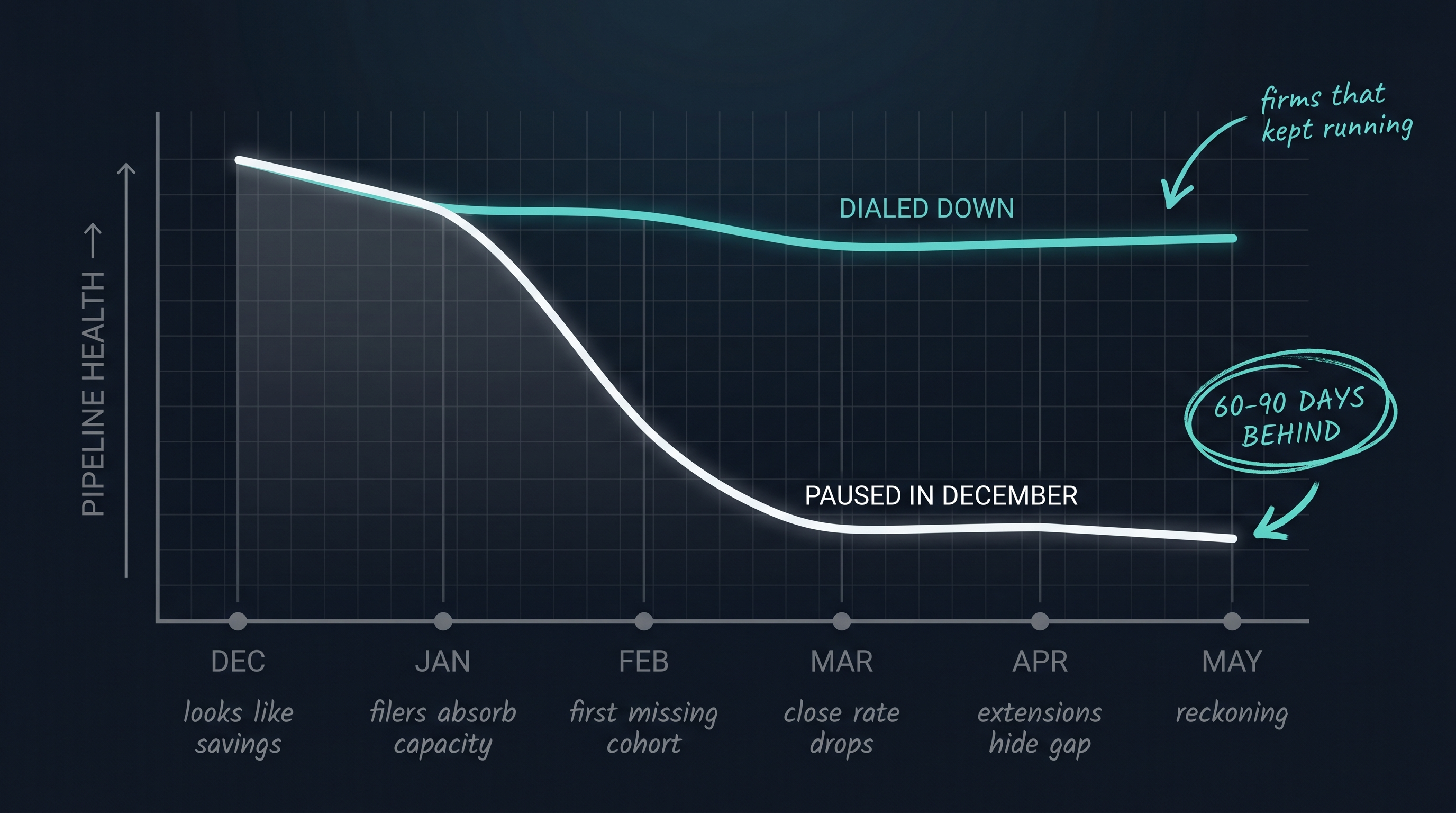
It’s May 2026. Accounting firms that paused Meta ads in December are sitting on calendars that should be full and aren’t. The pipeline they killed five months ago can’t be rebuilt in five weeks. Most are right now 60 to 90 days behind where they would be if they had kept running through tax season.
This isn’t a prediction. It’s the post-mortem, in real time.
Why are so many accounting firms quiet in May 2026?
I run Meta ads for accounting firms full time. The pattern I see every May is the same one I watched for seven years inside Corvee and Instead, coaching firms under Andrew and Amanda Argue. The firms that paused marketing through tax season are now the ones with the slow calendars.
Trade press is calling out the same pattern from a different seat. CPA Practice Advisor’s May 1 piece by David A. Perez framed it as “The Dark Season.” His argument: the assumption that Q2 is rest time for accounting firms is what creates the growth barrier. He’s right. Same pattern, different angle.
The numbers back it up. 93% of accounting firms either maintained or grew their marketing budgets in 2026. High-growth firms invest about 9% of revenue in marketing and grow 3.5x faster than their peers. The firms in the pause-through-tax-season camp are a shrinking minority. They just happen to be the loud ones in May.
Should accountants pause marketing during tax season?
The pause logic feels obvious in December.
Calendar is full of returns. Team is buried. Ad budget feels wasteful when you can’t take on new tax clients anyway. Why not save the spend and pick it back up in April?
Here’s the thing. Paused ads don’t pause the sales cycle. They pause the input to a sales cycle that runs 45 to 75 days minimum.
That number isn’t theoretical. We covered the days-to-close math in our last post on the 45 to 75 day close window. The same math that kills campaigns at day 30 is what makes a December pause cost you May bookings. The calendar doesn’t care about your urgency.
There’s another cost most firms don’t price in. Meta’s learning phase resets when a campaign sits paused for more than 7 days. To exit the learning phase again, the ad set needs 50 attributed conversion events inside a 7-day window. A pause longer than a week means starting that count from zero when you restart. Reported relaunch CPL spikes run 30 to 50% above pre-pause levels for the first two weeks, with full convergence taking 45 to 60 days. The pause isn’t actually a savings. It just looks like one in December.
What actually happens to your pipeline from December to May when you pause ads?
This is the load-bearing observation of the post. A month-by-month breakdown of what we’re watching happen right now.
December: The pause looks like a savings
Calendar is full of returns from existing clients. Ad pause looks like a clean line in the P&L. Team is grateful for one less moving part. Nobody notices the top of the funnel going dark, because the work in front of them is the work that’s paying the bills.
January: Filers start showing up, ads still off
Filing season begins. Existing-client returns absorb 100% of capacity. Inbound calls are mostly from returning clients with quick questions, not from new prospects who are evaluating you. The funnel input is at zero. Nobody is paying attention to that yet because the team is heads-down.
February: The first missing cohort
This is when the prospects you would have warmed up in December should be booking calls. They aren’t. Because they were never warmed up in the first place. The symptom is invisible. No booked calls feels like the same heads-down work everyone is doing. But the pipeline has now been empty of new entries for 60 days.
March: Close rates drop and nobody knows why
The few inbound calls that do come in (referrals, old retargeting echo, organic search) feel colder than usual. They are colder. The first instinct is “the market is soft” or “tax season slowed everyone down.” Both are wrong. What’s actually happening is that the warm prospects in the funnel are gone, and what’s left is the cold ones who showed up despite the silence.
April: Extension revenue hides the gap
Extension filings buy a fake feeling of survival. Firms tell themselves they had a “fine” tax season. The pipeline truth is buried under a pile of 4868s. Cash is coming in from extensions, so the dashboards look OK, so nobody questions the absence of new client engagements.
May: The reckoning
Extensions are done. Filers have paid up and disappeared back into their normal lives. The tax planning calendar that should be filling up for Q3 is empty. This is where firms are, right now, in mid-May. The calendar they expected to be 70% booked through July is sitting at 20%.
Here’s the same six months in a single table:
| Month | What you’re seeing | What’s actually happening to pipeline |
|---|---|---|
| December | Calendar full, team grateful | Top of funnel goes dark |
| January | Filing season starts | Zero new prospects entering the system |
| February | Heads-down, returns shipping | First missing cohort. Symptoms invisible |
| March | Close rate drops, blamed on “soft market” | Cold inbounds feel cold because they are cold |
| April | Extensions mask the gap | Cash flow hides the funnel collapse |
| May | Tax planning calendar empty | The reckoning. 60 to 90 days behind |
Why can’t accounting firms just rebuild their pipeline in May?
Most firms restarting ads this week are expecting June bookings. The math doesn’t support that.
The cold prospect to booked appointment window for tax planning runs 45 to 75 days for the typical engagement. If a firm restarts on May 16, the earliest meaningful pipeline impact is mid-July. That is the absolute earliest, assuming everything else (creative, audience, sales process) is dialed.
Meanwhile, the firms that kept running through tax season have a warm audience that’s already mid-funnel. They aren’t restarting. They’re harvesting. That’s the gap.
The catch-up math actually gets worse from there. Restarting an ad account that’s been paused for 4+ months means Meta is re-learning the audience from a stale pixel. Cost per qualified appointment spikes 30 to 50% above pre-pause for the first two weeks. 2026 already shipped a 21% year-over-year increase in lead-objective CPL across the platform (from about $22.86 to $27.66), and conversion rates softened from 8.67% to 7.72%. The economics of restarting now are worse than the economics of never having stopped.
What do accounting firms with full May calendars have in common?
The firms with full tax planning calendars right now share one thing.
They didn’t pause.
Not “they had a better campaign” or “they got lucky with creative.” They just kept the funnel input running through tax season. Some dialed budgets down. Some didn’t. The defining variable is continuity, not optimization.
The principle that keeps showing up: a reduced ad budget through tax season costs less than a full restart in May, and produces a warm pipeline ready for the post-April push. Pausing saves December ad spend and costs three to five months of pipeline rebuild later. That math almost always loses.
| Approach | December spend | Top-of-funnel volume in Q1 | March close rate | May booked appointments | Time to rebuild |
|---|---|---|---|---|---|
| Paused in December | $0 | Zero new prospects | Drops with the cold inbounds | 20-40% of capacity | 60-90 days |
| Dialed down through tax season | ~40-60% of normal | Steady at reduced volume | Holds steady | 70-100% of capacity | None needed |
How do I rebuild my accounting firm’s pipeline after a tax season pause?
If you’re sitting on the wrong side of that table, here is the actual sequence. Five steps. No optimism, just the math.
- Restart now, even though it’s late. Every day you wait extends the rebuild window by a day. Mid-July bookings are better than no Q3 pipeline at all.
- Re-warm any retargeting audience first. Old website visitors and past video viewers are the cheapest, fastest path to a booked call. Spend the first two weeks there before going cold.
- Accept the 60 to 90 day delay. Plan around it. Don’t try to compress the window with aggressive offers. That attracts the wrong prospects and produces tire-kickers, not qualified appointments.
- Use May and June to rebuild, plan revenue for August through October. The Q2 calendar is mostly written at this point. Stop trying to fix Q2. Build for Q3.
- Track cost per qualified appointment, not cost per lead. The first two weeks of a restart will have ugly CPL numbers as Meta re-learns. CPQA is what matters. Watch that.
When should accounting firms restart marketing after tax season?
The honest answer is: don’t pause in the first place. Dial down.
The right call isn’t “pause in December, restart in April.” It’s “dial down to 40 to 60% of normal in late November, dial back up in mid-March, two weeks before the extension deadline.” Pipeline rebuild time is 45 to 75 days, so a mid-March dial-up produces a May and June booking flow. A May restart pushes that pipeline impact to late July at the earliest.
The firms running with full May calendars in 2026 didn’t restart in May. They never fully stopped. That is the entire difference.
Frequently asked questions about pausing accounting firm marketing through tax season
Should accounting firms pause marketing during tax season? No. Pausing ads in December feels like a savings, but it kills the top of the funnel that feeds your post-tax-season pipeline. The cold-to-booked window for tax planning engagements is 45 to 75 days. A December pause means an empty May calendar. The better move is to dial ad spend down 40 to 60% through tax season, not turn it off.
Why is my accounting firm’s pipeline slow in May 2026? If you paused Meta ads in December and didn’t restart until April or May, you’re sitting in a predictable pipeline gap. The prospects you would have warmed up in December never entered your funnel. By the time you restarted, the catch-up math added another 45 to 75 days. Firms in this position are typically 60 to 90 days behind where they would be if they had kept running.
How long does it take to rebuild an accounting firm’s pipeline after a tax season pause? 60 to 90 days minimum, sometimes longer. The cold-to-booked window for tax planning prospects is 45 to 75 days, so a May restart produces meaningful booked appointments in July at the earliest. Trying to compress that window with aggressive offers attracts the wrong prospects. The realistic plan is to restart now, accept the gap, and rebuild revenue for August through October.
When should accountants restart marketing after tax season? Mid-March, not May. Two weeks before the April extension deadline is the right restart point. Because the cold-to-booked window is 45 to 75 days, a mid-March dial-up produces booked appointments in May and June. A May restart pushes that pipeline impact to late July. The firms with full May calendars in 2026 didn’t restart in May. They never fully stopped.
Is it cheaper to pause ads during tax season or dial them down? Dialing down is cheaper over the full calendar year. Pausing saves on December ad spend but costs three to five months of pipeline rebuild later. A 40 to 60% spend reduction through tax season keeps the funnel warm, costs roughly half of normal monthly spend, and avoids the May reckoning. The pause-then-restart math almost always loses to the dial-down-then-dial-up math.
What does a 60-day pipeline gap actually cost an accounting firm? For a firm doing $500K to $5M in revenue with a $2,500+ average engagement, a 60-day gap typically costs 8 to 15 missed booked appointments. At a 30 to 40% close rate, that’s 3 to 6 missed engagements. The pause that looked like a savings in December usually costs 5 to 10x what was saved when the full revenue picture is in.
If you’re reading this in May and your calendar is empty
You’re not alone. You’re not in a soft market. You made a December decision that cost you a May calendar.
The math is fixable. It just takes time you don’t get to compress. Book a 45-minute strategy call and we’ll walk through the rebuild on the actual numbers in your firm.