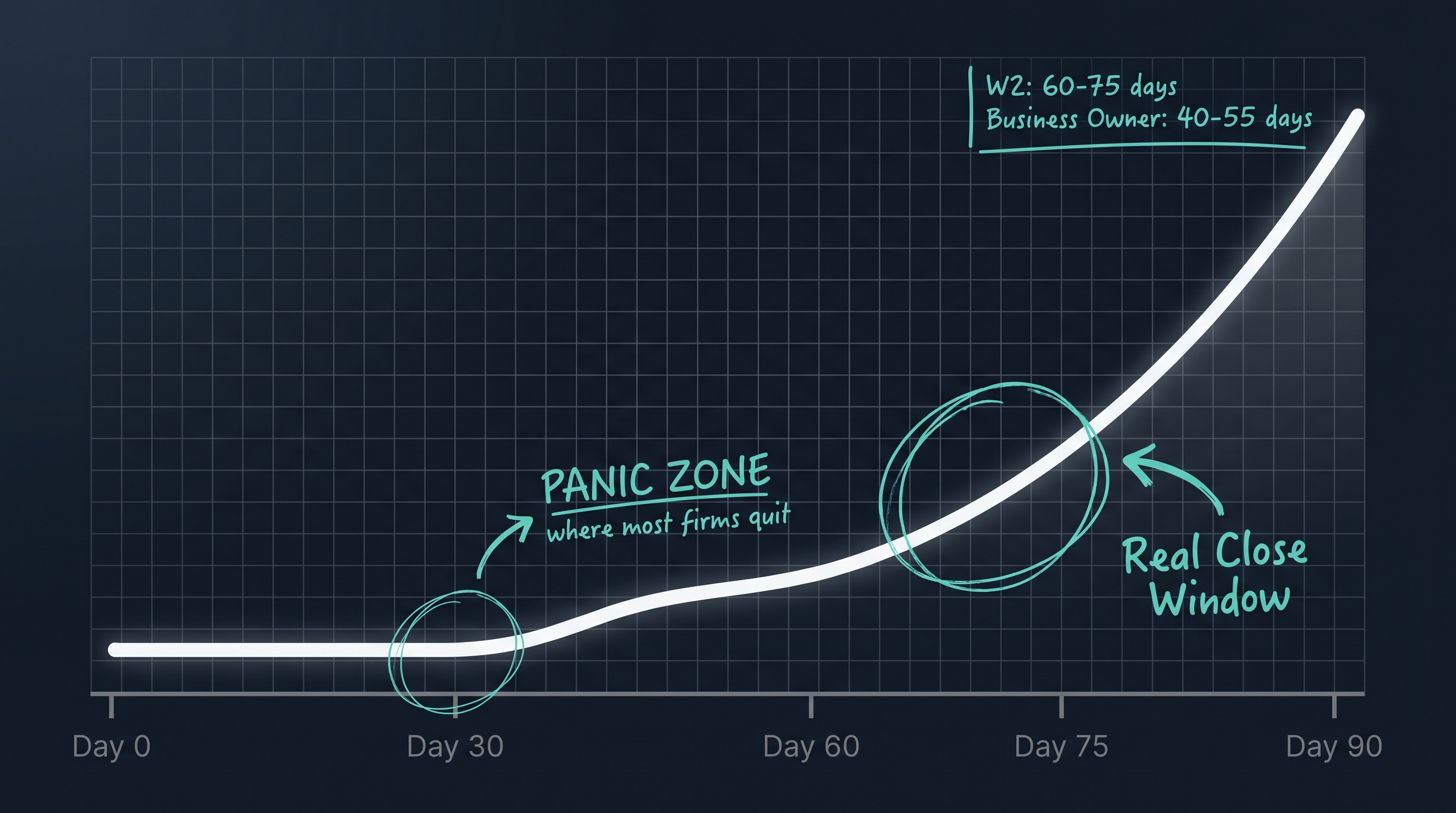
Stop Killing Ad Campaigns at Day 30. Your Real Close Window Is 45 to 75 Days.
We run Meta ads for accounting firms in the $500K to $5M revenue range. Every quarter, I watch the same mistake play out.
Days to close for tax and accounting firms runs 40 to 75 days, depending on the prospect type. Business owners typically close in 40 to 55 days. High-income W2 prospects take 60 to 75 days. Most firms expect a 30-day close, panic at day 40, and kill the campaign right before the pipeline matures.
If you’re judging your ad spend at day 30, you’re judging it on 5 to 15% of the revenue it will eventually produce. That’s not a marketing problem. That’s a measurement problem.
What is “days to close” for an accounting firm?
Days to close is the number of days between a prospect’s first touchpoint with your firm and the moment they sign your engagement letter.
It is not the same as:
| Metric | Definition |
|---|---|
| Days to booked appointment | First touch → calendar booking |
| Days to first call | First touch → first conversation |
| Days to close | First touch → signed engagement letter |
Most accounting firms only track the first two and assume the third looks similar. It does not. The gap between booked appointment and signed engagement is where most ad campaigns get killed.
Days to close benchmarks for tax and accounting firms
These numbers come from running Meta ads across dozens of accounting firms in the $500K to $5M revenue band. The pattern is consistent enough to publish:
| Prospect Type | Service | Median Days to Close | Range |
|---|---|---|---|
| High-income W2 individual | Tax planning | 67 | 60-75 |
| Business owner ($500K-$5M revenue) | Tax planning + advisory | 47 | 40-55 |
| Filing-only prospect | Annual return | 28 | 21-35 |
For context: across all B2B services, the median sales cycle is 84 days according to Growthspree’s 2026 sales cycle benchmark report, up 22% since 2022. CSO Insights data via HubSpot shows 74.6% of B2B deals close within four months. Tax planning sits inside that band. Advisory engagements run on the longer end because the buyer has to trust your firm with sensitive financial decisions, not just a tax return.
The 30-day expectation most firms walk in with is not a benchmark. It is a story they told themselves.
Why firms kill accounting ad campaigns 30 to 45 days too early
Here’s what happens.
A firm spins up Meta ads. Day 1 through 20, qualified appointments start booking. Day 30 rolls around. Booked appointments are stacking, but nobody has signed yet. The owner gets nervous and calls the agency. “Where are the clients?”
The agency says “be patient.” The owner reads that as a stall. Day 40 hits. Still no closes on the board. The owner kills spend.
Three months later, that same audience is being run by a competitor’s agency. The original firm’s pipeline, the one that was about to mature, gets harvested by someone else.
I watched this pattern play out for seven years inside Corvee and Instead, coaching accounting firms under Andrew and Amanda Argue. Same panic. Same kill. Same regret 90 days later when the competitor is signing the prospects that were ready to close.
Growthspree’s 2026 ad benchmark data backs the pattern. By day 30, your dashboard typically shows 5 to 15% of the revenue the campaign will eventually produce. Killing at day 30 is killing the 8x ROAS that materializes at day 180.
Five signs your firm is about to make the 30-day mistake:
- You’re measuring cost-per-lead instead of cost-per-qualified-appointment
- You’re reading Meta’s default dashboard, which uses a 7-day click + 1-day view attribution window
- You haven’t tracked any prospect past their second touchpoint
- Your sales team’s follow-up cadence ends at day 14
- You’re treating the campaign’s first 30 days as if they represent the whole campaign
Any two of those, and you’re going to kill a campaign that was working.
Why high-income W2 prospects take 60 to 75 days to close
W2 earners do not run a business. Their tax pain is annual, not operational.
That changes everything about the funnel. They need more proof. More education. Almost always a spouse conversation before they sign anything north of a few thousand dollars in fees. They are not shopping the way a business owner shops.
The funnel has to be built for that timeline:
- Long-form VSL on the landing page, not a 90-second pitch
- Email nurture sequence with at least 6 to 8 touchpoints
- Retargeting cadence that runs 60 days minimum
- Case studies matched to their income band (most accounting case studies feature business owners, which is wrong for W2 audiences)
If you’re running a 14-day email sequence to a W2 buyer, you’re tapping out at the exact moment they’re starting to seriously consider you.
Why business owners close in 40 to 55 days
Business owners feel tax pain weekly, not annually.
They’re already paying a CPA. They’re already half-shopping most of the time. Shorter deliberation cycle. Three to five trigger events per year, not one annual reckoning:
- Quarterly estimated payments
- K-1 surprises
- Payroll questions tied to S-Corp salary thresholds
- Depreciation timing decisions
- Year-end planning windows
Each event creates a reason to look. By the time a business owner clicks your ad, they’ve usually had at least one of those events recently. The funnel can be tighter. The proof can be sharper. The close can be faster.
Different psychology, different funnel.
How accounting firms should measure ad campaign performance
Stop measuring cost per lead. Start measuring cost per qualified appointment.
We track booked, qualified, ready-to-talk appointments like our life blood. Not impressions. Not clicks. Not raw form fills. The only metric that matters at the top of the funnel is whether the prospect on the other end is qualified, showed up, and is actually ready to talk about becoming a client.
Speed also compounds. According to GoProposal’s data, same-day engagement letter delivery closes at 85 to 90%. Two weeks out drops below 50%. The longer your operational lag, the worse your ad ROAS looks, and the more tempted you are to blame the ads.
The 4 metrics every accounting firm should track on Meta ad campaigns:
- Cost per qualified appointment (CPQA). The leading indicator.
- Show rate. Operational indicator. Above 60% is the floor.
- Days to close. Pipeline maturity indicator.
- Closed engagements per 75 days of spend. The only number that actually runs the business.
Skip impressions, clicks, and raw lead counts. They will lie to you in both directions.
Show rate alone can swing the entire economics of an ad account. On one client’s pipeline we took show rate from 23% in one quarter to 74% in the next, by retargeting booked appointments with practice info before the call. The setter-to-closer handoff matters more than the ads themselves. The ads only have to deliver the booking. Everything from that moment forward decides whether the campaign math works.
Same principle on the data side. We’ve cut cost per result by 25% on accounts just by feeding accurate first-party data into Meta’s pixel: Facebook Click ID, browser ID, click parameters. Most agencies skip this work entirely. It’s the difference between Meta optimizing toward warm prospects and optimizing toward whoever clicked first.
How long should an accounting firm run Meta ads before evaluating performance?
Run Meta ads for a minimum of 90 days before you judge campaign performance. If your median days-to-close is 60 days, you need at least one full close cycle plus a learning window. Anything shorter is gambling on noise.
Here’s the math, broken down:
- Day 0 to 30: Meta is learning. Pixel seasoning, audience optimization, creative testing. You are paying for data.
- Day 30 to 60: The first cohort of qualified appointments hits the pipeline. Show rate stabilizes. CPQA settles.
- Day 60 to 90: First closes from that first cohort start landing. Real ROAS visible for the first time.
- Day 90 and beyond: You have one full cycle of data. Now you can judge.
Two weeks ago we helped close an $80K tax planning engagement. That prospect first touched the funnel 62 days earlier. If the firm had killed the campaign at day 30, that contract would not have existed.
That single contract paid for the full year of ad spend on that account.
Signs your accounting firm’s pipeline is maturing (not failing)
Six signals to watch between day 30 and day 75:
- Booked appointments per week are flat or growing, even if closes are still zero
- Qualification rate has stabilized (the percentage of bookings that show up qualified)
- No-show rate is dropping
- Second-call rate is climbing (prospects are coming back for follow-up conversations)
- Cost per qualified appointment is flat or falling
- Your sales team is asking for more appointments, not fewer
All six can be true at day 60 with zero closes on the board. That is not a failing campaign. That is a maturing pipeline.
When the dashboard panics you, the dashboard is wrong. The pipeline tells the truth.
Frequently asked questions about days to close for accounting firms
How long does it take to close a tax client from a Meta ad? For business owners, 40 to 55 days median. For high-income W2 individuals, 60 to 75 days. Filing-only prospects close faster, around 28 days median. These benchmarks come from running ads for accounting firms in the $500K to $5M revenue range.
What is the average sales cycle for an accounting firm? For advisory and tax planning engagements, 45 to 75 days from first touchpoint to signed engagement letter. Filing-only work runs faster (21 to 35 days). The figure depends heavily on prospect type and offer complexity.
How many days should I run Meta ads before evaluating results? Minimum 90 days. Meta needs 30 days for learning and pixel seasoning. Your pipeline needs another 30 to 60 days to surface real closes. Anything shorter is judging on incomplete data.
Why do high-income W2 prospects take longer to close than business owners? W2 earners face annual tax pain, not weekly. Lower deliberation pressure. Most need spouse alignment before signing. Business owners feel quarterly pain through estimates, K-1 surprises, and payroll decisions, so they shop and decide faster.
What metrics should an accounting firm track on Meta ad campaigns? Cost per qualified appointment, not cost per lead. Show rate (above 60% is healthy). Days to close. Closed engagements per 75 days of spend. Skip impressions, clicks, and raw lead counts.
The accountable way to run Meta ads for your accounting firm
Here’s the thing. The 30-day kill switch is not a marketing problem. It is an operating problem.
You can’t run a 75-day sales cycle through a 7-day attribution window. You can’t judge a campaign on 15% of its eventual revenue. And you can’t expect a 30-day close from an engagement that needs three months of trust to land.
Three rules I run by:
- Measure your firm’s days-to-close before you spend a dollar on ads. Know your own number.
- Set the evaluation window at 90 days minimum. Lock it. Don’t move it because the dashboard looked ugly on day 35.
- Track qualified appointments and show rate weekly. Track closes monthly. Don’t conflate the two.
If you’re running ads for an accounting firm and want to see what a 90-day evaluation framework actually looks like in practice, book a 45-minute strategy call.